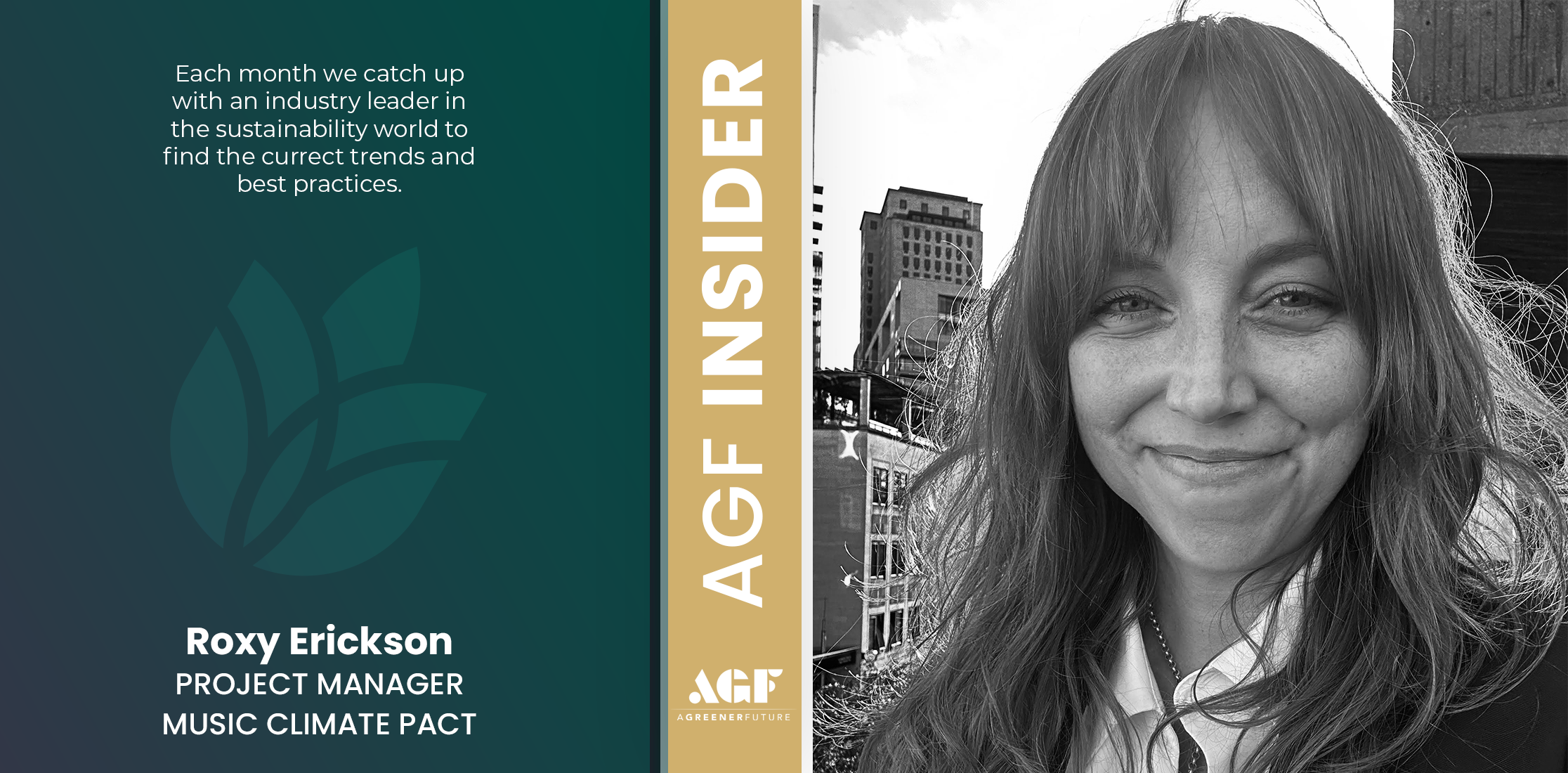
Welcome to AGF Insider, our insightful series where we bring you monthly interviews with industry experts.
Each month we catch up with an industry leader in the sustainability world to find the current trends and best practices
This month, we catch up with Music Climate Pact’s Project Manager Roxy Erickson.
What trends are you seeing this year?
On the live side, I’d say a real impact-based focus on material emissions, particularly eradicating fossil fuels from power and transport. Initiatives like the Show Must Go On report’s Climate Transition Plan to 2030 are maturing the conversation.
We have gamechangers like KB Events hauling Sam Fender's gear on electric trucks and Lorde and FORWARDS festival playing on a hydrogen-fuelled stage thanks to the West of England Clean Power Pilot and GeoPura's Hydrogen Power Units. Likewise, Boomtown's Hydro XL, one of the UK's first fully hydrogen-powered festival stages, doubled in size for 2026.
These are built on legacy now as well; that’s where things start to get exciting. This wasn’t year one for Boomtown, and we owe thanks to others who moved the needle, like Massive Attack's Act 1.5 show in 2024, and the public conversations that folks like Billie Eilish and Coldplay had before that.
I’d love to see the 2027 festival season fuelled by more cleaner power than fossil fuels. There just aren't good reasons for it not to be.
On the recorded side, policy is driving greater awareness. A few weeks ago, the Music Climate Pact and Seismic hosted a webinar on "Navigating Sustainability & Green Claims in the Music Industry". Despite the technical focus on incoming EU legislation, over 150 people signed up from across the industry, many of whom wouldn't usually see themselves as part of this conversation. Across every sector, knowing how to do your job sustainably is becoming integral, and some level of climate training will soon simply be expected.
What are the obstacles?
There are always some not-yet-solvables, single-use tents and cups, for instance, that keep those working in sustainability chipping away, looking for the big win. These conversations are tough because they are so visible and have the opportunity to create the mindset shift needed, but are often time-consuming without offering the perfect solution.
A low-impact journey to and from the event is part of the positive experience for audiences every time. Audience travel is approximately 40% of a festival's emissions, but events are experimenting and working on that last mile. Just over a third of Glastonbury's ticket-holders now arrive by cycling or public transport and the festival experimented with a “I came by train” campaign in collaboration with artists to get more folks travelling that way. Green Man has partnered with Red Fox Cycling since 2022 to offer guided group rides from Bristol and offers free bike lock-ups.
These initiatives are excellent, but big changes from organisations outside the music industry will be necessary to move the needle all the way. We will need to collaborate extensively and use the creative sector’s ingenuity and lobbying power to clear these obstacles.
What’s the next big thing in sustainability in events?
No- and low-meat events: Many of us still love eating meat, and it's a hard habit to question when society still accepts it as normal practice even when we know the damage it does to the environment and our bodies. But it's a conversation we'll regret not pushing harder on as a sector. Project Slingshot's TfL campaign on factory farming this year shows progress is being made.
Food and drink make up over a third of the average festival’s carbon footprint, and serving beef is starting to feel “uncool”. Most people can eat outside their norm for a weekend: Shambala has run meat- and fish-free for years with no drop in appetite, Flow Festival in Helsinki has served no red meat or poultry since 2022, BM Park Live went fully vegetarian in 2025, and Cannes has banned beef from its own catering. Events like Veganuary Fest are making meat-free the exciting choice, not the compromise. Events are a great place to show attendees how delicious food doesn't need to hurt future generations.
With UK food shortages being forecast, events can show that eating within planetary boundaries offers hope rather than fear.
What would be the biggest game changer from your perspective?
Am I allowed to say the climate emergency itself? Staying neutral on climate in comms is getting harder, and audiences now expect to see it reflected. Summer 2026 was the UK's hottest on record, with five heatwaves and the driest July since 1836. Harry Styles' team relaxed Wembley's water bottle policy and offered discounted water and free sun cream, festival campsites turned to dust, and pitches for sport fared no better.
Beyond that, there's the world-building nature of festivals. Touring has shown what's possible with clean power and transport, and festivals with food and audience engagement. The public now expects events to actively demonstrate sustainability, not just be less bad.
That's a genuine opportunity for music in particular, because we already have the evidence that festivals change people’s view of the world. A Yale team studying attendees at festivals, including Latitude, found most reported transformative experiences, feeling more connected to humanity and more willing to help strangers, with effects lasting months.
Festivals are one of the few places where tens of thousands of people can live a joyful, low-carbon world for a weekend. If they can stay resilient to climate breakdown while modelling the future people want, the biggest game changer may be the mindset shift of festival-goers.
Keep an eye out for next month's edition of AGF Insider, where we'll bring you more expert perspectives and fresh ideas!
